
Dating Culture Journal
Metropolitan Matchmaking: Dating Culture in Seoul, Tokyo and Hong Kong
Three East Asian capitals, three completely different sets of rules for turning interest into a relationship.
Men who succeed in Tokyo often stall in Seoul, and the approach that works in Hong Kong can feel abrupt in both. The difference is not language or looks - it is pace, the way intent is signaled, and the moment a relationship becomes official. This guide compares the three cities as they actually work for Western men in 2026.
Why One Asian Dating Playbook Does Not Travel
Courtship pace, directness and family visibility differ sharply between Tokyo, Seoul and Hong Kong, even though the three cities sit within a four-hour flight of each other. East Asian dating culture as a whole is shaped by Confucian values - hierarchy, respect for elders and social harmony - which produce structured, staged relationships rather than open-ended casual dating. Early conversations are reserved, emotional openness grows gradually, and family approval carries real weight before any engagement.
But the shared frame hides big practical differences. Tokyo formalizes the start of a relationship with a spoken confession. Seoul celebrates milestones almost from week one, yet keeps an official ambiguous stage before that. Hong Kong runs on international schedules and moves faster than either. Understanding which rhythm you are in prevents the two most common mistakes: assuming exclusivity too early, or waiting so long that interest quietly fades. Our verified Asian dating platform exists precisely because that context is hard to learn from a swipe app.
City comparison
Tokyo, Seoul and Hong Kong: Three Dating Rhythms Compared
Each city rewards a different sequence of moves. Read the card that matches where you are heading first.
Tokyo

Tokyo runs on an explicit confession. A relationship in Japan begins with kokuhaku (告白), a spoken declaration of feelings, usually phrased as tsukiatte kudasai - "please go out with me". Until that sentence is said, both people are considered free, even after several enjoyable dates.
That single convention removes the Western "figuring it out" phase entirely. There is no gradual slide into exclusivity: before kokuhaku you are not a couple, after it you are, immediately. Western men typically get this wrong in one of two directions - assuming three dates equal a relationship, or waiting months for a signal that only arrives once someone says the words.
The rest of Tokyo courtship is quiet and considerate rather than demonstrative. Punctuality is read as respect, and small seasonal omiyage souvenirs communicate attentiveness better than compliments. If you are planning a trip, our Japanese dating guide covers the etiquette in detail.
Seoul
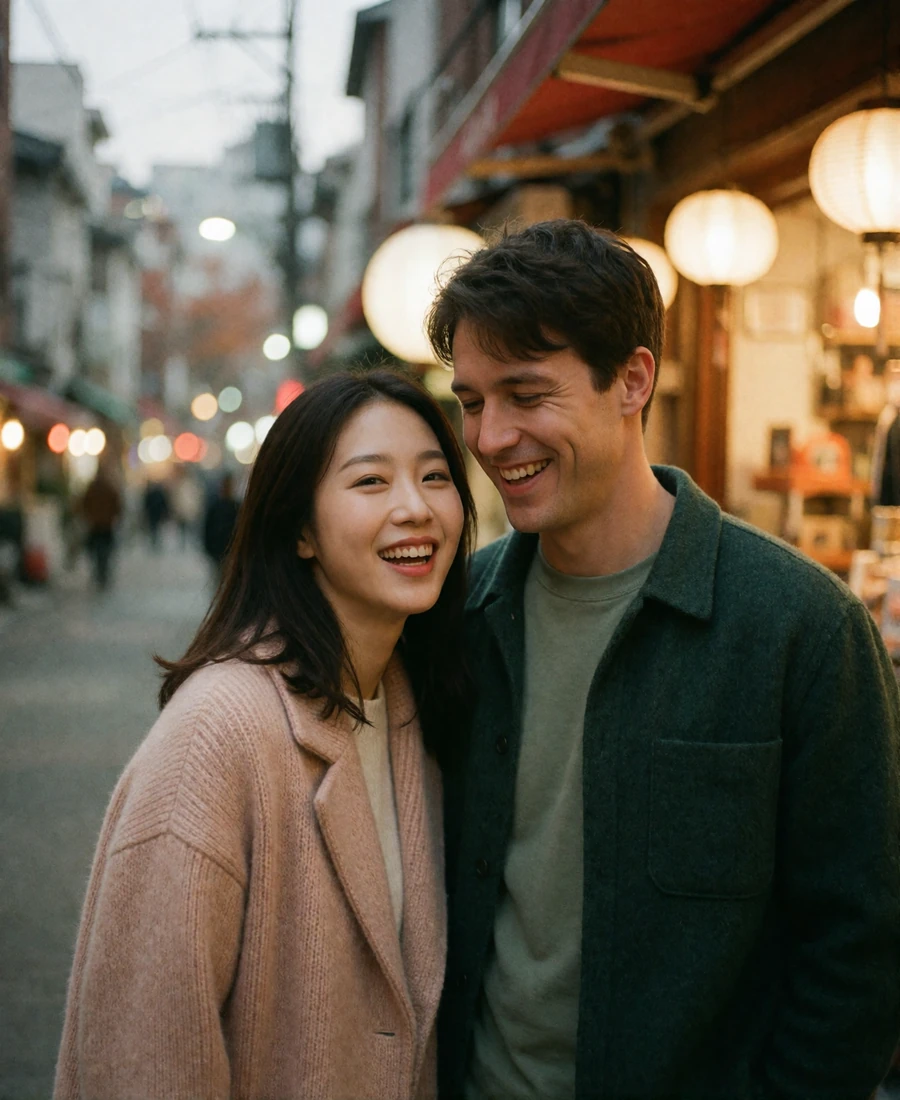
Seoul builds a relationship in visible milestones - after an ambiguous audition. Korean dating has a named in-between stage called sseom (썸): interest is obvious to everyone, but no one has made it official yet. It is not a rejection; it is an evaluation period, and patience plus consistency is what carries you through it.
Once the relationship is confirmed, the pace flips. Couple culture is strong and highly visible - matching outfits, shared accessories, and anniversaries counted in days rather than years. The 100-day mark, baegil (백일), is celebrated as seriously as a first anniversary in the West, complete with couple rings and a proper dinner.
Family enters the picture earlier here than in Hong Kong. According to the Korean Institute for Health and Social Affairs, 64% of South Korean women expect to meet a partner's parents within the first six months. Start with our Korean dating guide before you plan that visit.
Hong Kong

The Hong Kong dating scene is the fastest and most international of the three. The city concentrates finance, law, shipping and consulting into a small area, and dating adapts to that density. Meetings get scheduled between commitments, and compatibility is assessed early and openly rather than over months of gentle signaling.
English is widely used in professional life, which lowers the language barrier but raises expectations: vague plans read as low interest. Being specific about a time, a place and your intentions is treated as competence, not pressure. There is no equivalent of kokuhaku here - the conversation about exclusivity is simply had directly.
Family influence has not disappeared, though. Chinese cultural expectations around a partner's stability and seriousness still shape long-term decisions, even among women who date independently. Our Chinese dating guide explains how family expectations and career ambition coexist.
Practical Tips for Western Men Dating in East Asian Capitals
The single most useful adjustment is learning to read indirect communication. East Asian cultures are high-context: silence or a change of subject can signal discomfort rather than agreement, and "I'll think about it" usually means no. Reading only the literal words is how a promising conversation quietly ends without either person understanding why.
The second adjustment is pacing. Emotional openness grows gradually across all three cities, so an early declaration of strong feelings tends to create distance instead of closeness. What consistently works is steady, unhurried contact: showing up when you said you would, remembering details, and letting warmth accumulate rather than announcing it. Gallup research from 2025 found that 73% of Japanese women consider quiet reliability more attractive than verbal expressiveness - a preference that travels well across the region.
- Confirm intent explicitly once. In Tokyo that means kokuhaku; in Hong Kong it means one direct conversation. Never assume exclusivity from date count alone.
- Be consistent during ambiguity. Korea's sseom stage rewards steady contact far more than dramatic gestures or calculated silence.
- Treat punctuality as courtship. Arriving early and confirming plans in advance reads as respect in all three cities.
- Dress for the city, not for the airport. Grooming standards are high; our guide to what to wear on dates in Asian capitals breaks it down city by city.

Choose the City, Then Choose the Approach
There is no single East Asian dating style. Tokyo asks you to say the words out loud, Seoul asks you to stay steady through ambiguity and then celebrate every milestone, and Hong Kong asks you to be clear and to respect a crowded calendar. Pick the culture that fits how you actually communicate, learn its one defining convention, and the rest follows naturally. Whichever city you choose, verification and honest pacing matter more than any opening line - which is exactly what a serious cross-cultural platform should give you.
Verified Asian dating Japanese Dating Korean Dating The expat dating scene in Asia
Quick answers
Frequently Asked Questions
The questions men ask most often before their first trip to Tokyo, Seoul or Hong Kong.
What dating app do Asians use the most?
Usage is country-specific rather than continent-wide. The largest country-focused platforms belong to Cupid Media: AsianDating reports 4.5 million members, FilipinoCupid 3.5 million and ThaiCupid 1.5 million, each requiring a separate account. MatchAsian covers women from 33 Asian countries through a single verified profile.
What is the 3 day rule in Korea?
The "three-day rule" is dating folklore, not a Korean tradition: the idea that you should wait roughly three days before texting after a first meeting. Korean courtship has a real ambiguity stage instead, called sseom, where interest is obvious but nothing is official. Consistency reads better than calculated delay.
How does confession etiquette work on a date in Tokyo?
In Japan, exclusivity begins with kokuhaku, a spoken confession of feelings, typically phrased as "tsukiatte kudasai". Before that moment both people are considered free, even after several dates. After it, the couple is exclusive immediately, with no gradual Western-style transition period.
What is the Hong Kong dating scene like for Western men?
The Hong Kong dating scene is fast, international and schedule-driven. Many women there work long hours in finance, law or logistics and evaluate compatibility quickly. Calendars matter more than courtship rituals, and family introductions usually arrive later than in Seoul or Tokyo.